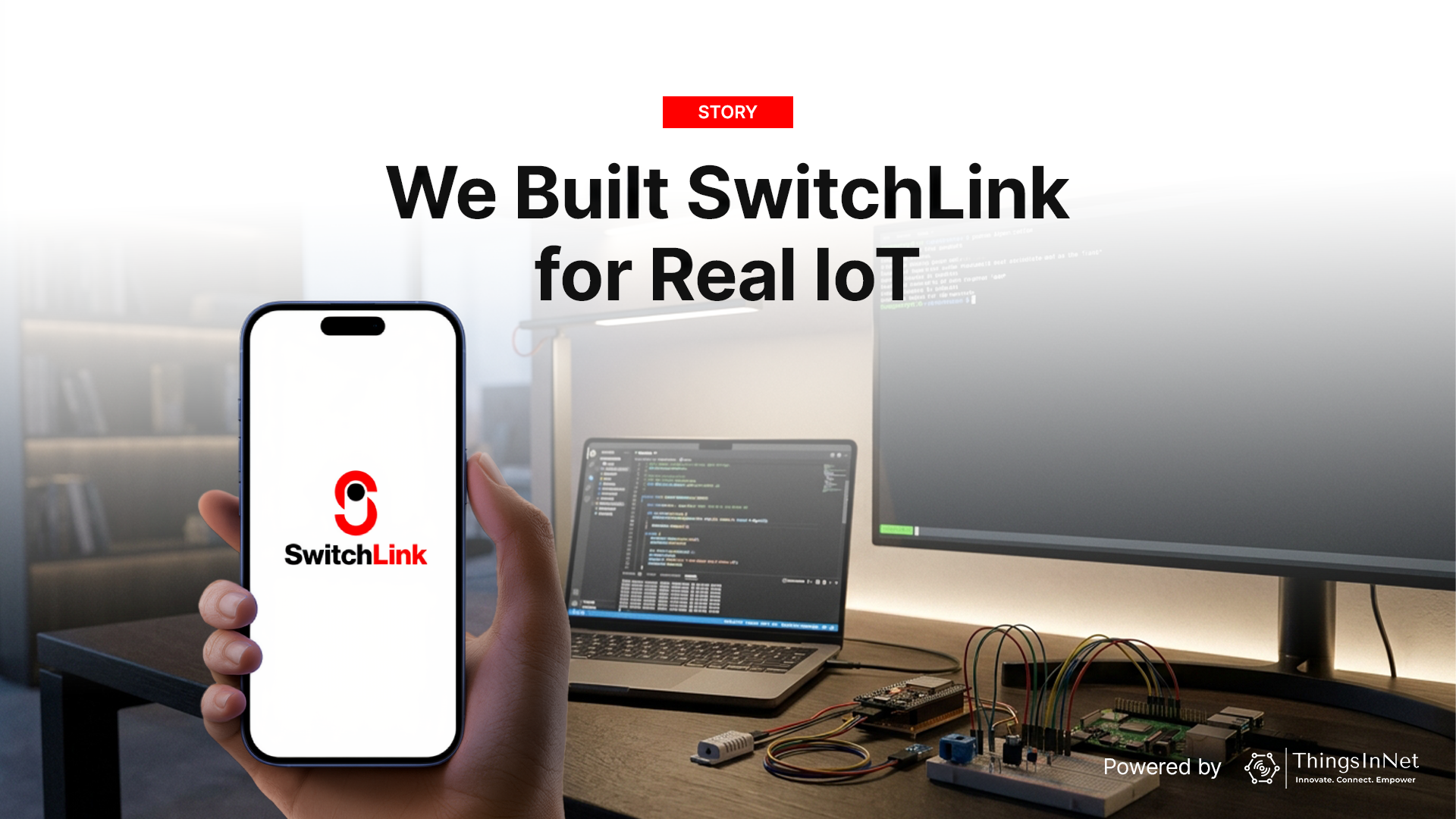
The Internet of Things (IoT) is transforming how people interact with devices, data, and automation systems across industries.
From smart homes and agriculture to industrial monitoring, education, and research, connected devices have become an essential part of modern innovation. As IoT adoption continues to grow, developers and organizations increasingly need platforms that are scalable, accessible, and easy to integrate into their own ecosystems.
This is the vision behind SwitchLink.
SwitchLink was created to provide developers, startups, educational institutions, and businesses with a practical and cost-effective platform for building real-time IoT solutions while maintaining ownership and control of their infrastructure.
The Need for More Flexible IoT Solutions
Many established IoT platforms in the market offer robust capabilities for device connectivity, dashboards, cloud services, and mobile integration.
For example, platforms such as Blynk are widely recognized for rapid prototyping, dashboard development, and managed cloud services, while Tuya is commonly used in smart home ecosystems and OEM device deployments.
These platforms serve important roles in the IoT ecosystem and are well suited to specific commercial use cases.
However, some users may require a solution that offers:
- greater infrastructure ownership
- simplified backend flexibility
- cost-effective scaling for smaller deployments
- learning-friendly architecture for education and research
- reduced dependency on third-party ecosystems
This is where SwitchLink was designed to provide an alternative approach.
Introducing SwitchLink
SwitchLink is built around a simple principle:
Your device + your database + your application = your IoT ecosystem
Rather than relying exclusively on a proprietary cloud environment, SwitchLink enables real-time device communication through the user’s own Firebase Realtime Database infrastructure.
This approach helps users maintain:
- full ownership of their data
- control over cloud credentials
- flexible integration options
- scalable system architecture
- long-term portability
By reducing platform dependency, SwitchLink supports a development model focused on transparency and control.
Built for Real-World Development
SwitchLink supports widely used embedded hardware and microcontroller platforms, including:
- ESP32
- ESP8266
- Raspberry Pi
- STM32
- compatible MCU-based systems
This makes it suitable for a wide range of use cases such as:
- smart farming and irrigation control
- sensor monitoring dashboards
- smart building automation
- industrial process monitoring
- academic prototypes and MVPs
One of SwitchLink’s core strengths is its support forautomatic dashboard generation.
For instance, structured variable naming conventions such as:
- w_relay1
- r_temperature
- r_humidity
can be automatically interpreted into corresponding UI controls and live monitoring elements within the mobile application.
This reduces front-end development time and helps teams focus on device logic and system performance.
Designed with Affordability in Mind
Cost remains one of the most important considerations in IoT deployment, especially for:
- students
- startups
- research teams
- pilot deployments
- educational institutions
SwitchLink is intentionally positioned as an affordable solution, with pricing designed to support experimentation, learning, and early-stage deployment.
Pricing
- $3 per month
- $24 annually
This makes it especially suitable for long-term prototypes, academic projects, and early-stage commercial validation, where budget efficiency is essential.
Supporting Long-Term Ownership
A key principle behind SwitchLink is reducing dependency on closed ecosystems.
By allowing users to work with their own backend infrastructure, SwitchLink helps preserve:
- data ownership
- architecture independence
- deployment flexibility
- future migration options
This approach can be particularly valuable for businesses and institutions that prioritize long-term scalability and system governance.
Ideal for Education and Research
Beyond product deployment, SwitchLink also serves as a strong platform for learning and experimentation.
Because users work directly with real-time databases, cloud communication, and device control logic, the platform supports practical understanding of core IoT concepts, including:
- real-time data exchange
- control signal architecture
- cloud-device synchronization
- scalable backend design
- mobile-to-device communication
This makes it well suited for:
- engineering laboratories
- university projects
- embedded systems courses
- final-year research work
- IoT curriculum development
Looking Ahead
We believe the future of IoT development should be:
- affordable
- scalable
- transparent
- developer-centric
SwitchLink was built to help make connected system development more accessible, whether for first-time student projects or growing commercial solutions.
Our goal is simple:
Enable smarter IoT development with greater ownership, flexibility, and cost efficiency.
Final Thoughts
SwitchLink is designed for teams and individuals who value:
- affordability
- infrastructure control
- scalable real-time communication
- development flexibility
- long-term ownership
It offers a practical alternative for building modern IoT solutions while keeping the system architecture in the hands of the user.
That is the foundation of the SwitchLink vision.